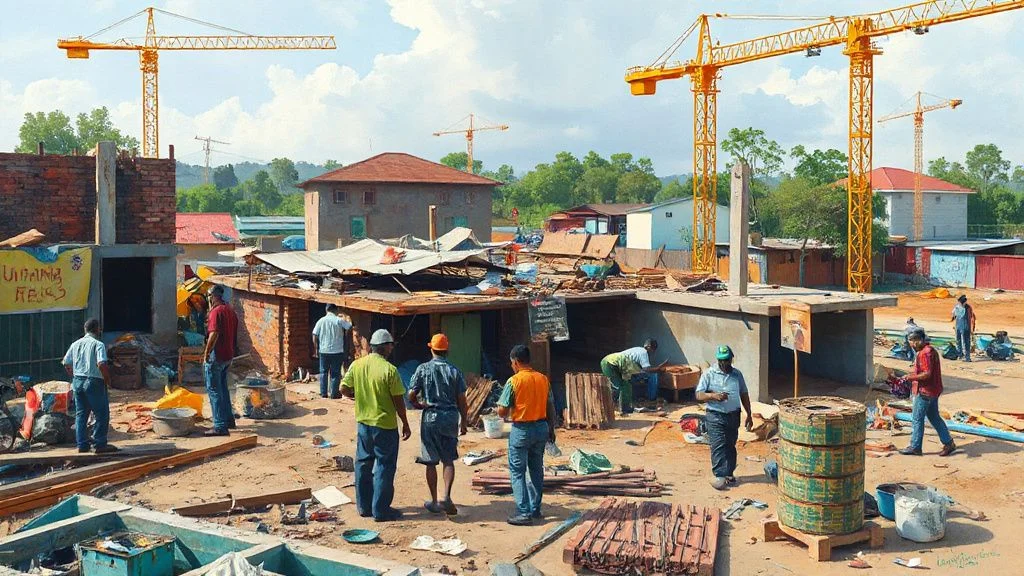
Understanding the financial landscape of construction roles on public projects in Suriname is crucial for both job seekers and employers. This article delves into salary expectations, contract norms, and the regulatory environment that governs public construction projects in the country. By the end, you will have a clearer picture of what to expect when engaging in construction work within the public sector.
Salary Expectations for Construction Roles
In Suriname, the salaries for construction roles on public projects can vary significantly based on several factors, including the type of project, the contractor's reputation, and the specific role within the construction team. While exact figures for salaries in public construction roles are not consistently published, industry insights suggest that wages are typically aligned with local standards for skilled labor.
For instance, roles such as construction foremen, project managers, and specialized tradespeople (like electricians and plumbers) generally command higher salaries compared to general laborers. According to the Ministry of Public Works, the remuneration for skilled labor in construction is often set by the contractor based on the project's budget and scope, which can lead to variations in pay.
Typical Salary Ranges
What this role pays cannot responsibly be given as a range here, and the reason is simply that no such range is published. Suriname has no published salary scale per occupation: the Algemeen Bureau voor de Statistiek issues no wage benchmark by job title, no ministry publishes a pay table for private-sector work, and the figures that turn up on international salary sites are modelled from other countries rather than measured here. The one wage figure that is both published and enforceable is the floor. The minimum hourly wage is SRD 61.25 gross per hour, set by Beschikking no. 777/26 of the Minister of Health, Welfare and Labour of 3 July 2026 on the advice of the Nationale Loonraad, published in the Advertentieblad van de Republiek Suriname, and in force since 1 July 2026; before that it was SRD 52.47 gross per hour, in force from 1 April 2025. No monthly minimum has been fixed, so any monthly equivalent of it is arithmetic and not an official amount.
For construction specifically there is one development worth knowing, because it changes who may hold the work rather than what it pays. The Wet Bedrijven en Beroepen (S.B. 2017 no. 40) was given effect for this sector by the Besluit Vakbekwaamheidscriteria, Beoordelingscommissie en Beroepenregister, a state decree of 31 May 2024 (S.B. 2024 no. 62), which implements articles 12 and 13 of that law. Its first phase covers architects, consulting engineers, contractors for building and civil engineering works, and technicians, who have to meet the competence criteria in the decree's annexes and register in the professional register held at the Kamer van Koophandel en Fabrieken. On a public project that registration is the kind of thing a client checks, so it is worth asking the employer which registered professional the work is being carried out under.
That still leaves a good deal you can establish before accepting an offer. Ask for the gross wage per hour or per month in writing and check it against the statutory minimum hourly wage. Ask which collective labour agreement applies, if any: a cao sets the wage scale for a sector, it may improve on the statutory floor but can never go below it, and a new cao has to be registered with the Ministry of Labour within fifteen days of signing, so whether one exists is a matter of record rather than of opinion. Then ask what will be withheld. Wage tax is progressive, at 8% on monthly wages up to SRD 3,500 then 18% up to SRD 7,000 then 28% up to SRD 10,500 and 38% above that, with a tax-free allowance of SRD 9,000 a month below which nothing is withheld at all. Overtime is taxed from its own rate table rather than from these brackets, and a gratuity is exempt up to SRD 19,500 a year. Those rules come from the Wet Loonbelasting (S.B. 1981 no. 181) as the Belastingdienst publishes it, and they tell you more about take-home pay than any salary range on the internet will. One caution worth carrying: the wage-tax page on gov.sr is out of date and still names a far lower tax-free allowance, so a government domain is not by itself proof that a figure is current.
It is important to note that these figures are approximate and should be verified with official sources or industry contacts. Additionally, salaries may be influenced by the contractor's financial capacity and the project's funding source, particularly for government-funded initiatives.
Understanding Contracts in Public Construction
Contracts in the construction sector are typically governed by Suriname's legal framework, which is based on Dutch civil law. When working on public projects, it is essential to understand the types of contracts that may be involved. The most common contract types include fixed-price contracts, cost-plus contracts, and unit price contracts.
Fixed-price contracts are often used for public projects, where the contractor agrees to complete the project for a predetermined price. This type of contract places the risk of cost overruns on the contractor, incentivizing them to manage resources efficiently. Cost-plus contracts, on the other hand, allow contractors to be reimbursed for their costs plus an additional fee, which can lead to higher overall project costs. Unit price contracts are based on the quantity of work completed, making them suitable for projects where the scope may change.
Key Components of Construction Contracts
When entering into a contract for public construction work, several key components should be carefully reviewed:
- Scope of Work: Clearly define the tasks and responsibilities expected from the contractor.
- Payment Terms: Specify how and when payments will be made, including milestones and retainage provisions.
- Timeline: Establish a project schedule with deadlines for completion and penalties for delays.
- Quality Standards: Outline the quality expectations and compliance with local building codes and regulations.
- Dispute Resolution: Include mechanisms for resolving disputes, such as mediation or arbitration.
Consulting with a legal professional experienced in construction law can help ensure that all contract terms are favorable and compliant with local regulations.
Work Permits for Foreign Workers
For foreign candidates seeking employment in construction roles on public projects in Suriname, obtaining a work permit is a critical step. The process can be complex and varies based on the applicant's nationality and the specific job role. Generally, foreign workers must secure a work permit before commencing employment, which is issued by the Ministry of Labor.
The application process typically involves several steps:
- Job Offer: Secure a job offer from a registered contractor in Suriname.
- Documentation: Prepare necessary documents, including a valid passport, proof of qualifications, and a letter from the employer.
- Application Submission: Submit the application to the Ministry of Labor, along with any required fees.
- Approval Process: Wait for the Ministry to review the application, which can take several weeks.
It is advisable to start the work permit application process as early as possible to avoid delays. Additionally, foreign workers should be aware of the specific regulations that may apply to their nationality, as some countries may have different requirements.
Common Pitfalls to Avoid
When navigating the work permit process, there are several common pitfalls to avoid:
- Incomplete Documentation: Ensure all required documents are submitted in full to prevent delays in processing.
- Ignoring Local Regulations: Familiarize yourself with local labor laws and regulations to ensure compliance.
- Delays in Application: Submit applications well in advance of the intended start date to account for potential processing delays.
Consulting with a local legal expert can provide valuable guidance throughout the process and help mitigate these risks.
What to Expect During Interviews
Interviews for construction roles on public projects in Suriname may differ from those in other countries. Employers often focus on practical skills and experience, as well as the ability to work within a team. Candidates should be prepared to discuss their previous projects, specific roles, and any relevant certifications.
It is common for interviewers to ask situational questions that assess problem-solving abilities and adaptability in challenging environments. For example, candidates may be presented with a hypothetical construction issue and asked how they would address it. Demonstrating a solid understanding of safety protocols and local building codes can also enhance a candidate's appeal.
Preparing for the Interview
To prepare effectively for an interview in the construction sector, consider the following tips:
- Research the Company: Understand the contractor's past projects, reputation, and values.
- Review Your Experience: Be ready to discuss specific examples of your work and how it relates to the position.
- Practice Common Questions: Prepare answers for typical interview questions, focusing on your skills and experiences.
- Dress Appropriately: While construction environments may be casual, dressing professionally for the interview can make a positive impression.
Practical Tips for Job Seekers in Construction
For those seeking employment in construction roles on public projects in Suriname, here are some practical tips:
- Network: Build connections within the industry by attending local construction events and joining professional associations.
- Stay Informed: Keep up-to-date with the latest developments in construction regulations and industry trends.
- Consider Certifications: Obtaining relevant certifications can enhance your qualifications and improve job prospects.
- Be Flexible: Be open to various roles within the construction field, as this can lead to valuable experience and opportunities.
In conclusion, understanding the salary expectations, contract norms, and regulatory environment for construction roles on public projects in Suriname is essential for both job seekers and employers. By familiarizing yourself with the local labor market, navigating the work permit process, and preparing effectively for interviews, you can enhance your chances of success in this dynamic sector. Always consult official sources or legal professionals for the most accurate and personalized advice.
Primary Sources
Last updated: November 2026