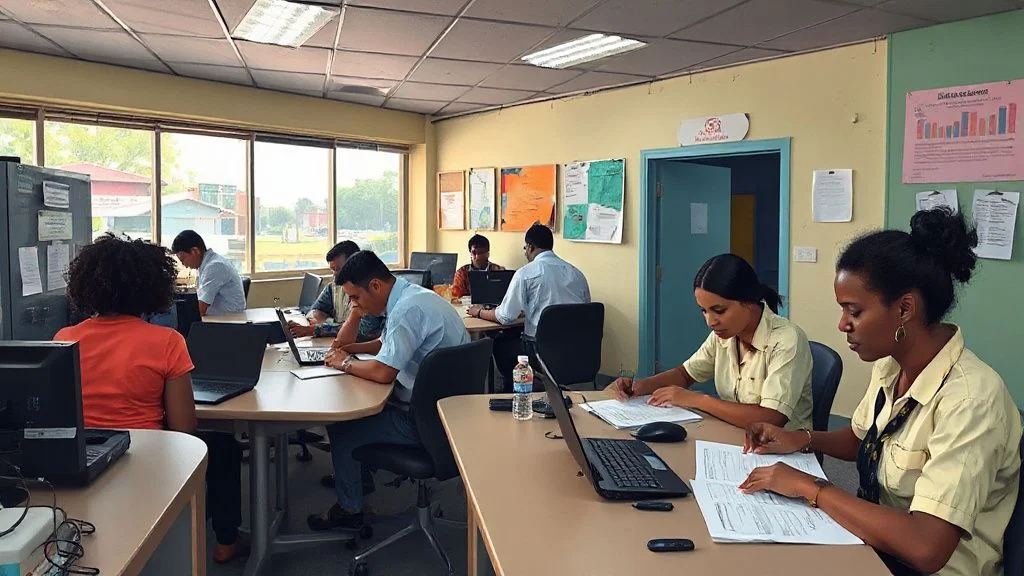
For recent graduates embarking on a traineeship in Suriname, understanding the nuances of overtime payment is crucial. This article delves into the legal framework surrounding traineeships, how overtime is calculated, and what you can expect in terms of compensation. By the end, you will have a comprehensive understanding of your rights and responsibilities regarding overtime during your traineeship.
Legal Framework for Traineeships in Suriname
Suriname has no labour code, and no "Labor Code of Suriname" exists to be quoted. Working hours and overtime are set by the Arbeidswet 1963 (Wet van 19 december 1963, G.B. 1963 no. 163); the employment contract itself sits in the Burgerlijk Wetboek. Article 3(1) of the Arbeidswet 1963 caps ordinary working time at 8.5 hours a day or 48 hours a week. There is no statutory 40-hour week here: forty hours is a contractual arrangement between employer and employee, and treating it as the legal threshold above which overtime starts will give you the wrong answer. Overtime beyond the statutory cap needs a permit from the Arbeidsinspectie, the Labour Inspectorate. Where it is permitted, the surcharge is 150% of the established wage outside the statutory rest days and 200% on a Sunday or a day treated as an equivalent rest day. On the ceiling that applies under such a permit the published sources contradict each other, the statute naming 72 hours a week and 2.900 a year and a government page naming 64 hours a week, so neither figure should be relied on as settled.
Whether a traineeship counts as employment is not settled by anything called a "System of Labour Administration"; no such instrument exists in Surinamese law. It is settled by the facts of the arrangement. Where the trainee works under the employer's direction and receives wages, it is an employment contract under the Burgerlijk Wetboek, the Arbeidswet 1963 applies to it, and so does the statutory minimum hourly wage, whatever the paperwork calls the position. Where the placement is genuinely unpaid and arranged through a school as part of a course, there is no wage for those rules to attach to. Above that floor the specific terms do vary considerably by employer, and they are a matter for the agreement rather than for statute.
Understanding Overtime in Traineeships
Overtime is the time worked beyond the statutory ceiling in article 3(1) of the Arbeidswet 1963, which is 8.5 hours a day or 48 hours a week, and not simply the time beyond a forty-hour schedule. For a trainee the question that matters first is a different one: whether the arrangement is an employment contract at all. Where the trainee works under the employer's direction for wages, the Arbeidswet 1963 and the statutory minimum hourly wage apply as they do to any other employee, whatever the agreement is called. Where it is genuinely an unpaid educational placement arranged through a school, neither the surcharge nor the wage floor has a wage to attach to. Suriname has no separate statute for traineeships that sets its own overtime rules, so the label on the agreement does not change the answer; the facts of the working relationship do.
Which day the extra hours fall on decides the surcharge, and this is where the figures in circulation go wrong most often. The government's working-hours guidance sets 150% of the established wage for overtime outside the statutory rest days and 200% on a Sunday or a day treated as an equivalent rest day. Two hundred percent is a rest-day rule, not a reward for the third or fourth overtime hour of an ordinary working day; no tier by hour number appears in the published sources, and a rest day does not attract the ordinary-day percentage either. Overtime also requires a permit from the Arbeidsinspectie before it is worked at all.
Typical Overtime Rates
While there is no fixed overtime rate mandated by law for traineeships in Suriname, it is common practice for employers to pay overtime at a rate of 1.5 times the regular hourly wage for hours worked beyond the standard 40-hour workweek. Some employers may offer even higher rates for overtime worked on weekends or public holidays.
There is no published salary scale per occupation in Suriname, so no worked example can tell you what your own hour is worth, and any article that invents a monthly salary and divides it by an assumed number of monthly hours is inventing both the salary and the divisor. What is published is the floor and the surcharge. The minimum hourly wage is SRD 61.25 gross per hour, set by Beschikking no. 777/26 of the Minister of Health, Welfare and Labour of 3 July 2026 on the advice of the Nationale Loonraad, published in the Advertentieblad van de Republiek Suriname, and in force since 1 July 2026; before that it was SRD 52.47 gross per hour, in force from 1 April 2025. No monthly minimum has been fixed, so the monthly equivalents in circulation are somebody's arithmetic rather than an official amount. Take the hourly wage from your own contract or payslip as the base, apply the percentage that fits the day the hours fell on, and ask your employer, or the Arbeidsinspectie, which hours were booked as overtime and under which permit.
Negotiating Overtime Terms in Your Traineeship Agreement
Before commencing a traineeship, recent graduates should carefully review and negotiate their traineeship agreements, particularly concerning overtime pay. Here are some practical steps to ensure that you are adequately compensated for any overtime work:
- Clarify Expectations: During the interview process, ask potential employers about their policies regarding overtime. Understanding how they handle additional hours will help set clear expectations from the start.
- Review the Agreement: Ensure that the traineeship agreement explicitly states the hourly wage, overtime rate, and conditions under which overtime is applicable. If these details are not included, request that they be added.
- Document Your Hours: Keep a detailed record of the hours you work, including any overtime. This documentation will be invaluable if there are any disputes regarding pay later on.
- Communicate Regularly: Maintain open communication with your supervisor about your workload. If you find yourself consistently working overtime, discuss this with them to ensure you are compensated fairly.
Common Pitfalls to Avoid
While navigating the world of traineeships, recent graduates should be aware of common pitfalls that can affect their overtime compensation:
- Assuming Overtime is Optional: Some trainees may feel pressured to work extra hours without compensation. Remember that you have the right to be paid for any overtime worked, and it’s essential to assert this right.
- Not Understanding the Agreement: Failing to thoroughly read and understand the traineeship agreement can lead to misunderstandings about pay and responsibilities. Take the time to review the document carefully.
- Neglecting to Keep Records: Without proper documentation of hours worked, it can be challenging to prove entitlement to overtime pay. Always track your hours diligently.
What to Expect in Terms of Salary
What a traineeship pays cannot be stated as a range here, and the ranges that circulate for Suriname have no published source behind them. There is no official salary scale per occupation or per sector, no published entry-level benchmark, and no survey by the Algemeen Bureau voor de Statistiek that sets a figure for trainee pay. The phrase "according to recent data" in an article that names no dataset is a warning sign rather than a source. What can be stated is the floor: a trainee who is in fact an employee is covered by the statutory minimum hourly wage, and anything above it is negotiated.
For a trainee taken on by a ministry or another part of the public service the terms follow the Personeelswet (G.B. 1962 no. 195) and the salary resolutions issued under it rather than a market range, so the question to ask is which function group the post sits in. In the private sector there is no published benchmark to compare against at all. The practical route is to ask the employer for the hourly wage and the function group in writing before accepting, and to check it against the statutory minimum hourly wage.
Salary Expectations by Sector
Here’s a breakdown of typical salary ranges for traineeships in various sectors in Suriname:
- Public service: set by the function group under the Personeelswet (G.B. 1962 no. 195) and the salary resolutions issued under it, not by a market range.
- Private sector: negotiated per employer, with the statutory minimum hourly wage as the only published floor and no official scale above it.
- Where a cao applies: the collective agreement for the sector sets the wage scale, and a new cao has to be registered with the Ministry of Labour within fifteen days of signing.
- Unpaid educational placements: where there is genuinely no wage, there is no wage floor and no surcharge to apply; ask what the arrangement is before you start.
These figures are approximate and can vary based on the specific organization and the trainee's qualifications. Always verify with official sources or industry contacts for the most accurate information.
Practical Tips for Recent Graduates
As you prepare for your traineeship, consider the following practical tips to maximize your experience and ensure fair compensation:
- Network: Connect with other recent graduates and professionals in your field. Networking can provide valuable insights into salary expectations and company cultures.
- Seek Mentorship: Find a mentor who can guide you through your traineeship. A mentor can help you navigate workplace dynamics and advocate for your rights.
- Stay Informed: Keep abreast of changes in labor laws and regulations in Suriname. Being informed will empower you to advocate for yourself effectively.
- Be Proactive: If you find yourself consistently working overtime, don’t hesitate to bring it up with your supervisor. Proactive communication can lead to better working conditions and compensation.
Conclusion
Understanding how overtime is paid during a traineeship in Suriname is essential for recent graduates. By familiarizing yourself with the legal framework, negotiating your traineeship agreement, and being aware of common pitfalls, you can ensure that you are fairly compensated for your work. Remember to document your hours, communicate openly with your employer, and stay informed about your rights. With this knowledge, you can navigate your traineeship confidently and set the stage for a successful career.
Primary Sources
Last updated: November 2026