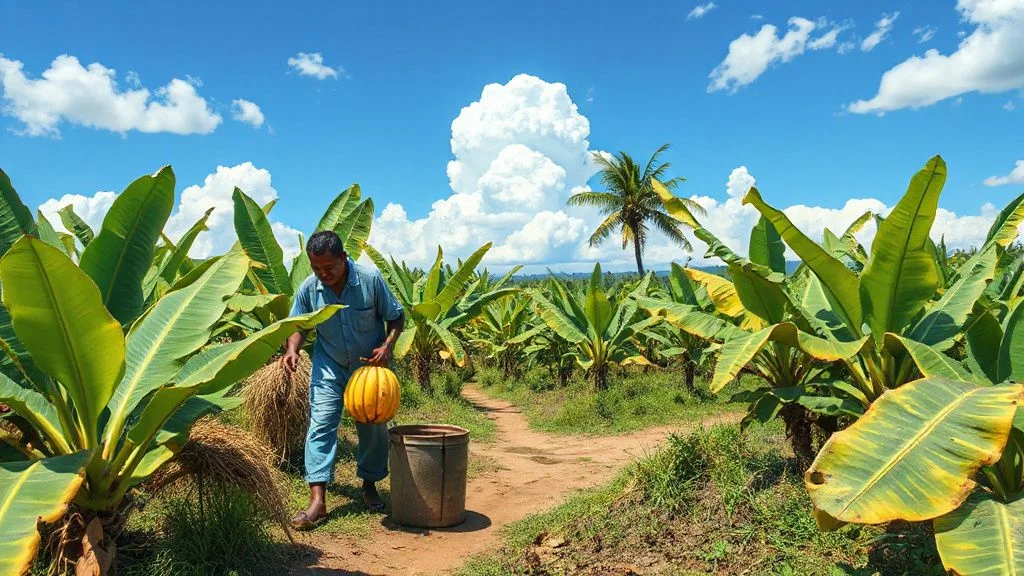
Banana growing in Suriname is a crucial sector, contributing to the food supply and also acting as an important engine of the local economy. This article explores the history of banana growing, the present state of the industry, the jobs it creates and what that means for job-seekers and expats in Suriname.
The History of Banana Growing in Suriname
Banana growing has a long history in Suriname, going back to the colonial period. In that time enslaved Africans were forced to work on the plantations, where the production of sugar and cocoa was the most common. Bananas have become an important product as well, however, above all in recent decades.
The largest plantation, Food and Agriculture Industries (FAI), was founded at the end of the last century and has been through a number of transformations. After a period of neglect and disease in the crops, the Surinamese government took the company over in 2019 and began a large-scale restructuring. That led to the replanting of 100 hectares of bananas, with plans for a further 100 hectares after that.
The Economic Mark of Banana Growing
Banana growing in Suriname plays a crucial part in the economy. It creates thousands of jobs, directly on the plantations and indirectly in the supply chain alike. In 2014 FAI had some 1,100 employees, which underlines the importance of the sector. The economy of Nickerie, where most bananas are grown, depends heavily on this industry.
The export of Surinamese bananas is aimed mainly at the Caribbean market. FAI exports containers weekly to countries such as Trinidad & Tobago and Barbados; the volume differs by season. That shows the regional appeal of Surinamese bananas, and also the need for a well-organised export infrastructure. The success of that export has a positive effect on local employment, since the number of jobs rises as production grows.
Jobs in Banana Growing
Banana growing offers various career possibilities for local residents and expats alike. Most jobs are seasonal and range from agricultural labourers to management positions. Typical roles include:
- Agricultural labourer: The basic role on the plantations, responsible for planting, tending and harvesting the bananas. The work calls for physical effort and knowledge of farming techniques.
- Quality inspector: This role takes in inspecting the bananas for quality and making sure they meet export standards. That is crucial for the markets the bananas go to.
- Logistics manager: Responsible for coordinating the transport of the bananas to the export points and for managing the supply chain.
- Support staff: This takes in roles such as administration, HR and marketing, all of which contribute to the running of the plantation.
What Expats Should Know About Working in Banana Growing
For expats considering work in banana growing, there are some important considerations. First, it matters to understand that most jobs in the sector call for considerable physical effort. That means many roles may not suit everyone. It is also essential to become familiar with local labour standards and workplace culture.
Another important aspect is obtaining a work permit. That can vary according to the role and the employer. It is advisable to be in good contact with the employer beforehand about the requirements for work permits and documentation. It can also be useful to contact local expat groups and forums for advice and support in finding your way through the process.
The Future of Banana Growing in Suriname
What the future of banana growing in Suriname holds depends on a number of factors. With demand for bananas in the region and plans for further expansion of the growing area, the sector may grow further. The Surinamese government and the companies involved are aware of the need to invest in sustainable farming methods and in technology so as to improve production and to keep the effect on the environment to a minimum.
There are also opportunities for innovation. The development of new banana varieties better able to withstand disease and variations in the climate can make a positive contribution to the sector. That offers opportunities not only for local people but for international experts with experience in agricultural technology.
Practical Tips for Job-Seekers
For those interested in a career in banana growing, here are some practical tips:
- Network: Make use of local networks, such as agricultural fairs and events. That can help in finding vacancies and in building relationships with employers.
- Learn the language: Knowledge of Dutch and Sranan Tongo can be a great advantage in talking with local colleagues and managers.
- Understand the culture: Suriname has a diverse population with various cultural backgrounds. It matters to show respect for that diversity and to adapt to local customs and standards.
- Research possible employers: Look at the history and the reputation of companies in the sector. That can help you make a well-considered choice in applying.
Conclusion
Banana growing in Suriname is a sector of great importance to the national economy and to employment in the country alike. The difficulties and the opportunities this industry offers make it a fascinating field for local job-seekers and expats alike. With the right preparation and knowledge it is possible to build a successful career in this dynamic sector.